
Pay once, use it forever. The pitch is seductive, and the skepticism it triggers is healthy. Anyone who’s watched a lifetime-deal tool vanish overnight, taking their money and their workflow with it, has earned the right to ask whether the whole model is marketing hype.
The honest answer is that both things are true. Some lifetime deals are the best money a creator will ever spend. Others are a $49 ticket to a shutdown notice. The difference isn’t luck; it’s a test, and most buyers never run it. This post runs it out loud, on the whole category, including Pyxa AI.
First, What "Lifetime" Actually Means
A lifetime license is a single payment for access that doesn’t expire, renew, or charge you monthly or annually. However, “lifetime” doesn’t refer to the customer’s lifetime; it refers to the product’s lifetime. Should the product turn off, the license turns off. It’s the first thing in any honest discussion, and that’s where most of the risk is.
This is especially relevant for AI applications compared to most types of software. Products with expensive per-user server costs (storage, streaming, AI compute) have a hard time still offering lifetime pricing, and thus have more frequent caps or shutdowns. An AI platform sells lifetime use of something that is priced per use. That’s a very real conflict, and any lifetime AI deal that doesn’t account for that is asking to not account for that.
The Break-Even Math: One Line
The math is very straightforward: lifetime price/monthly price = months to break even. An annual fee is justified when the up-front cost is below about two years of the subscription, and you know you’ll be using the program for several years. A one-time fee is justified if the up-front cost is less than about two years of the subscription, and you know you will be using the program for several years, and the vendor’s durability is half the decision.
It’s typically about 5-6 months of the subscription price that vendors charge for lifetime deals, which is what makes the break-even point generally less than a year. Pyxa AI is the “extreme” version of that pattern: $49.99 one-time vs. $259 a month — a break-even in days, not months. The math in that comparison is not the proof in and of itself, and this comparison is just on the trustworthiness of the model; the actual math for that comparison is in our earlier post on whether a $49 lifetime deal can replace $259 a month in AI tools.
However, break-even is just one half of the equation; the other half is that the vendor must survive. After eight months, a vendor’s demise means that a $49 “lifetime” subscription actually costs $6.13 per month, which is worse than many monthly subscriptions. If they do close their doors after three months, that $149 deal would cost $49.67 per month, which is higher than the $29 subscription it replaced. The break-even point is a math problem. The real question is, what is the likelihood that the vendor is around long enough for you to find out the savings?
The Shutdown Risk, Honestly Stated
What is this probability then? The straightforward response is that it varies, and the range itself provides some insight.
According to AppSumo’s own statistics, just about 5% of all the tools they’ve launched have ever died. But independent buyer tracking tells a more difficult story: Of the 118 deals tracked by one buyer, he found about 60 per cent were still useful and running, 20 per cent had been superseded by better workflows, 15 per cent were closed and not recovered, and 5 per cent were refunded within the window. DealKeep’s graveyard records 89 recorded instances of a lifetime deal going wrong, with approximately 81% of these being outright closures and about 1 in 8 being instances where buyers’ access to the deal was lost, but the tool continued to run.
The risk is also density-dependent within category. Live video and webinar platforms have the biggest risk of being shut down because servers and bandwidth are more costly than the lifetime revenue. And one analysis says that about 30% of generic AI wrapper deals won’t have a defensible moat, and won’t last two years past the point where it’s just a prompt slapped over another API’s product.
Together, read the numbers and the picture emerges: lifetime deals are not a lottery, but they’re not a sure thing either. Between 1 in 6 and 1 in 20 deals fail. There is never an abstract question of whether lifetime deals are worth it. It is “is this deal worth it?” and it’s a test you can do in 10 minutes.
The 6-Question Test
1. What’s the break-even, and is it under a year?
Divide the lifetime price by its equivalent per month. Less than 6 months is great; less than a year is good. If you’re over 30 months, it’s no longer the software you’re buying; it’s the company’s next three years. Pyxa AI is within a week of its $ 259-a-month comparison stack breaking even.
2. Is there a real refund window?
The money-back guarantee is a conversion of the bet into a trial. A quiet red flag is no window to refund the high price if it is a lifetime price. AppSumo deals are valid for 60 days, while Pyxa AI is valid for 7 days. Short, but real, and 7 days is sufficient to try out a suite before committing.
3. Are the limits honest, or does it promise “unlimited”?
This is the one question that reveals the most. The worst-case profile is an AI-driven service that makes unlimited claims with high processing fees, no export, and no use-of-service disclaimers. The real version is the sustainable lifetime deal; Pyxa AI’s token levels (Master Creator 200,000 word tokens, Ultimate Creator 1,000,000, Premium Creator 2,000,000) are just that: tokens that never run out and get renewed every year for lifetime members! A cap you can see is a promise that the company can keep; an ‘unlimited’ from an AI is a promise it can’t.
4. Can you take your work with you?
The insurance policy is export and portability. The philosophy behind the chat import feature at the center of Pyxa AI is the opposite of years of AI conversations in one place. The chat import feature at the heart of Pyxa AI is years of AI conversations in one place, but it’s yours, not your vendor’s. Any tool that aids in bringing in your past is a tool that is respecting your exit.
5. Is the vendor actually healthy?
Check for development activity, for support that responds, for a true product that’s broad, not a single feature wrapper. 24/7 support, five suites of 28 tools, and in-platform ticketing are the hallmarks of a platform, not a weekend project. When an API that a wrapper is using reprices, the wrapper dies, and a platform with its own width has a place it can move to.
6. What happens to your data if it fails?
If the answer is “you lose everything”, the price of the deal should take that risk into account. If your work is exportable, and you’ve got a history that’s portable, a shutdown is nothing more than a minor pain.
When a Subscription Actually Wins
A fair test admits the other side. A subscription wins whenever flexibility is worth more than the long-run discount. If you need the tool for three months, subscribe. If you need enterprise support, compliance guarantees, or a dedicated account team, subscribe. If you’re not sure you’ll use it at all, subscribe for a month and find out, a lifetime deal you never use is the worst purchase of all, and roughly a third of lifetime deals in one tracked sample were bought and never really used.
The subscription’s real advantage is the exit: cancel and move on, losing only the current month. The lifetime deal’s switching cost if it fails is high; you lose the upfront investment. That’s the trade, stated plainly, and for short-term or uncertain use, it’s the right trade to make.
The Verdict on Pyxa AI
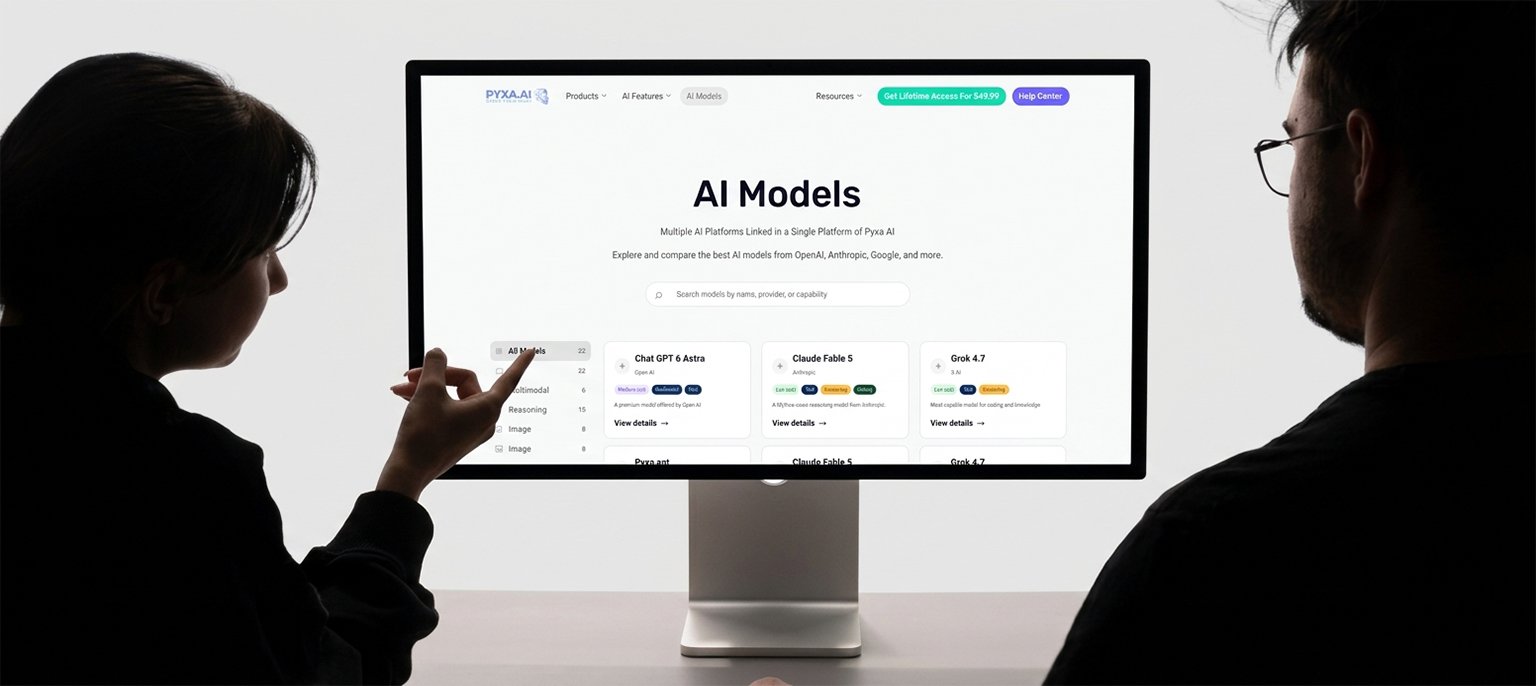
Run the test on Pyxa AI, and it holds up: break-even under a week against its comparison stack; a real 7-day guarantee; honest capped token tiers instead of an unsustainable “unlimited” promise; data portability built into the product; a 28-tool platform rather than a wrapper; and a $49.99 price where even the worst case, the tool vanishing after a year, still works out cheaper than a single month of the equivalent subscriptions.
That’s not hype. That’s a deal that passes its own test, which is the only kind of lifetime deal worth buying.
The Bottom Line
Lifetime AI deals aren’t hype, and they aren’t magic; they’re a bet on a vendor, priced in months. Run the six-question test, do the break-even math, and check the refund window before you buy. The deals that pass are the best value in software. The ones that don’t are the ones that fill the graveyards.
Pyxa AI: $49.99 once. Twenty-eight tools. Tokens that never expire. Seven days to change your mind.