There are 36 AI subscription plans from 9 providers right now, from free to $300 a month, plus 29 API models behind them. Twenty models worth comparing, each behind its own $20-a-month wall. Pay for all of them, and you’re spending hundreds a month just to find out which one writes best.
Nobody does that. What smart creators do instead is compare models inside one subscription, and there’s a right way and a wrong way to do it. This post covers both: the aggregator math, the comparison method that actually tells you something, and the honest limits nobody puts on the pricing page.
The Cost of Comparing, Done the Expensive Way
Begin with the four “flagship” families. ChatGPT Plus costs $20 a month, Claude Pro is $20, Google AI Pro is $19.99, and SuperGrok Premium is $30. That’s $89.99 per month, $22.50 per family, four models, four bills, four logins, four apps, none of which communicate with each other.
Now take that up to twenty models. Really, you can’t: there aren’t twenty $20 plans, since there are smaller labs that sell their models via APIs and bigger labs that sell their models in tiers. And that’s the rule: “Each lab provides some type of $20/month subscription, but just for their own models.” The most costly research method in AI is to subscribe to each lab. That is not even the cheapest option to consider either; you’d be paying per token for each model, creating your own comparison harness, and only after you write your first prompt would you have anything to compare.
The Aggregator Answer: One Bill, Many Models
The market solved this with aggregators: one app, one bill, models from several companies inside it. Yes, one subscription can cover ChatGPT, Claude, and Gemini models: Poe, Magai, T3 Chat, and Bento all sell one, with prices running from about $4 to $200 a month.
The market solved this with aggregators: one app, one bill, models from several companies inside it. Yes, one subscription can cover ChatGPT, Claude and Gemini models: Poe, Magai, T3 Chat and Bento all sell one, with prices running from about $4 to $200 a month.
Poe (from Quora) puts 100-plus models behind one login, Claude, GPT, Gemini, Grok, DeepSeek, Llama, Mistral, plus image, video, and audio generators. Its $19.99 Premium plan covers ChatGPT, Claude, and Gemini, plus Grok and DeepSeek and the image and video models, switching between them with a dropdown, against roughly $60 for the three main plans alone. Poe Basic, at $4.99 a month, reaches all four flagship families for $1.25 a family.
Magai runs $20, $40, and $200 a month. T3 Chat is reported at $8 and $50. ChatHub Pro shows up to six models side by side for $19 a month. Whizi Pro at $29.99 is the cheapest plan that shows two model families in side-by-side columns, each in its own chat you can keep talking to.
The aggregator pitch is simple and true: you switch between models instead of paying each lab separately. But the pricing has a trap worth knowing. Poe sells points, not messages, and the free allowance was cut from 3,000 points a day to about 300 around the end of March 2026. Heavy-duty flagship models burn through 300 points fast, and every plan can buy extra points at $30 per million. The cheapest aggregator plan is cheap because the meter runs fastest on the models you most want to compare.
How to Compare Models Properly
Access is only half the problem. The other half is method, and most model comparisons fail it
Test by task, not by benchmark
Claude Opus 5.8 is ranked first, followed by Sonnet 56 and then GPT-4 Argon 53 and Gemini 4 Argon 53. Useful, but the score only compares to other scores within the same version of the index and cost per task is more important than cost per token, as reasoning models consume vastly different amounts of tokens on the same task. A better buy is a model that scores 58 and uses 1/3 of the number of tokens of a model that scores 56. That’s the higher-priced one.
Run the same prompt across models, on your real work
Not a generic prompt, your actual blog intro, your actual product description, your actual support reply. No matter what is said on the leaderboard, the model that wins your task is the one that wins. Claude is good at writing, ChatGPT at breadth, Gemini at research, Grok at real-time, but none of that counts until you see it in your own words.
Blind-test when it counts
Our previous writing comparison involved 134 participants judging blind on eight tasks, and the winner (4 of 8 rounds) wasn’t the one with the most marketing money. Get rid of the labels, and so does your own bias.
Compare the full answer, not the first paragraph
A model’s quality shows in the third section, the edge case, the follow-up question, where the weaker models drift, repeat themselves, or quietly contradict the opening. One-shot comparisons flatter the fast models and punish the careful ones.
The Aggregator's Honest Limits
Aggregators are the right tool for comparison, but they have real limits, and a credible post says so.
You lose the native extras: no ChatGPT Advanced Voice Mode, no Claude Projects or Artifacts exactly as Anthropic ships them, no Gemini Workspace integration, and capped access to video models. Poe sometimes trails the native apps by days when a new model launches. If your workflow lives inside a lab’s native features, Projects, scheduled tasks, deep Workspace integration, the aggregator is a comparison tool, not a replacement home.
And the meter never stops. Points, credits, pots, every aggregator rations the flagship models hardest, because that’s where their costs concentrate. Comparing twenty models is cheap. Using your favorite twenty times a day is where the bill arrives.
The Pyxa Answer: Compare, Then Use, In One Place
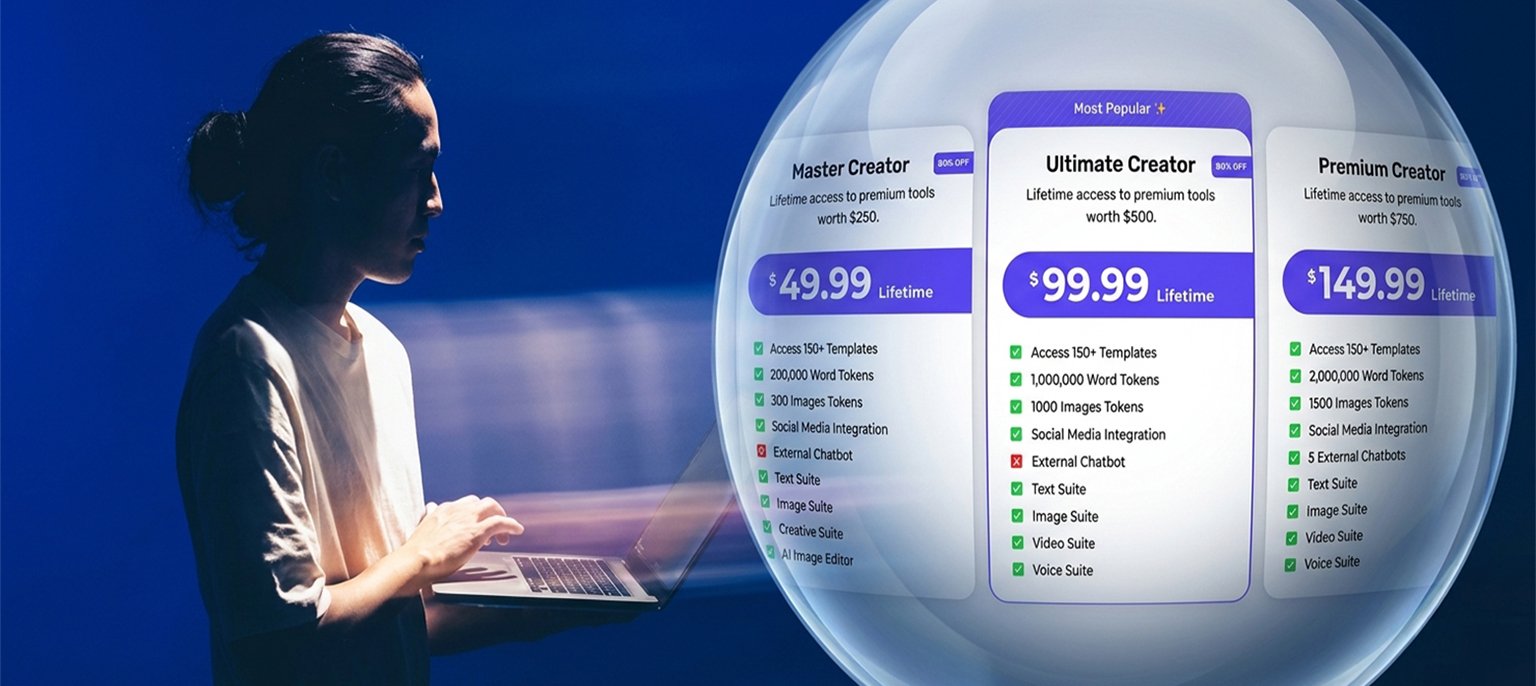
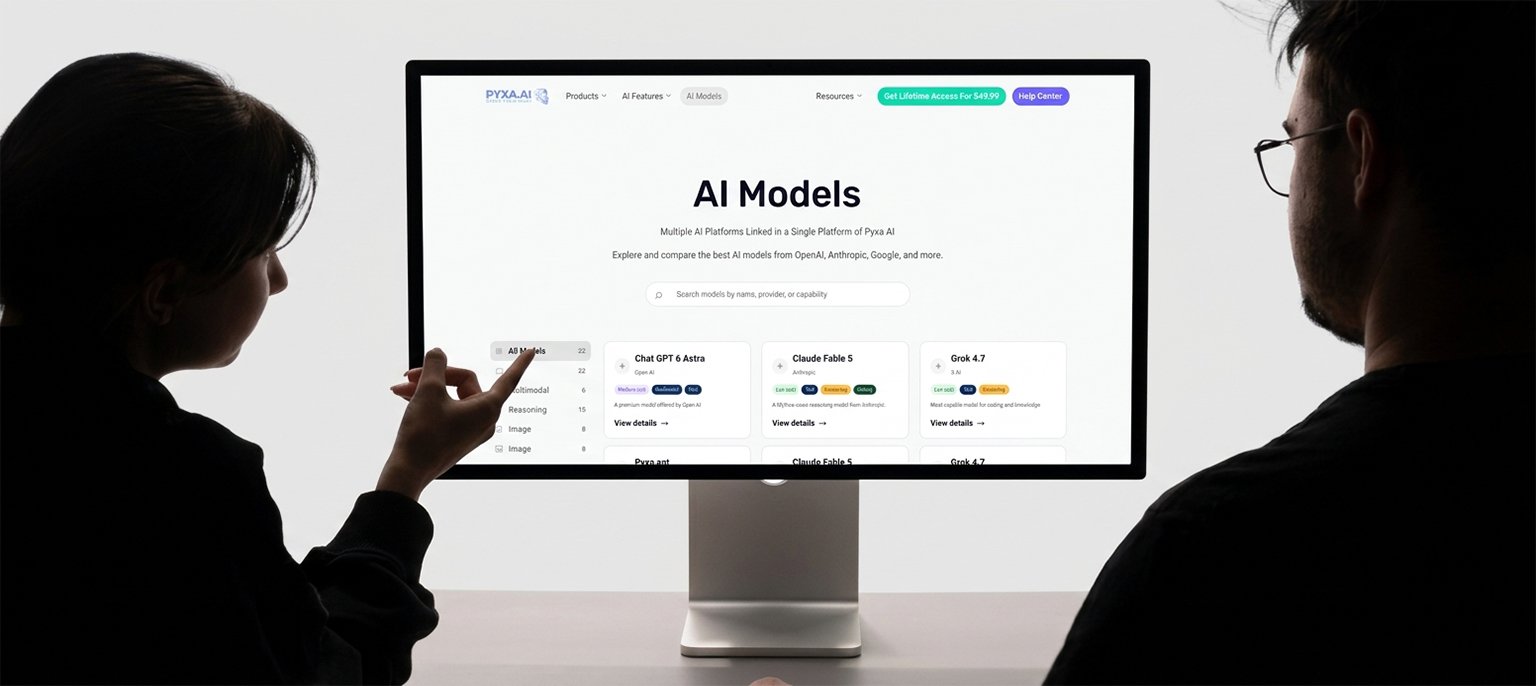
This is where Multi-Model AI is reshaping the answer shape with Pyxa AI. Pyxa does not have a “chat-only” aggregator that charges you per model access; instead, it unpacks multiple models into one workspace, which you can access for a one-time payment of $49.99, and then provides you with the entire workflow of the models, including the text generator with 150+ templates, SEO tools, visual suite, video generation, Voice & Audio Studio, social media management, and WordPress publishing without downloading a plugin.
The difference matters. Here on Poe, you compare the models and then move on to use the model that was “the winner”. In Pyxa, there are models to compare and, in the same login and the same Tier of models (Master Creator 200,000, Ultimate Creator 1,000,000, Premium Creator 2,000,000; word tokens that never expire, renewed each year), you use the winner, which goes directly into your image, your video, your voiceover, or your published post. The first step of the workflow is not a subscription; it’s comparison.
The price comparison is only in one line: four labs’ own plans are $89.99 a month, every month, forever. The lowest price Poe can get for his multi-model plan is $4.99 per month, each and every month. The models and the workflow cost $49.99 one-time; ten months of Poe Basic, or approximately two weeks of the four labs’ plans, is offered with a 7-day money-back guarantee.
The Bottom Line
Twenty models, twenty subscriptions, hundreds of dollars a month- that was never a serious way to compare. The serious way is one workspace, one bill, the same prompt across every model, judged on your real work. Aggregators made comparison affordable. Pyxa AI makes it permanent: compare the models, pick the winner, and build the whole piece in the same place, for $49.99, once.