ChatGPT, Claude, Gemini & Grok: Which One Actually Wins in 2026?

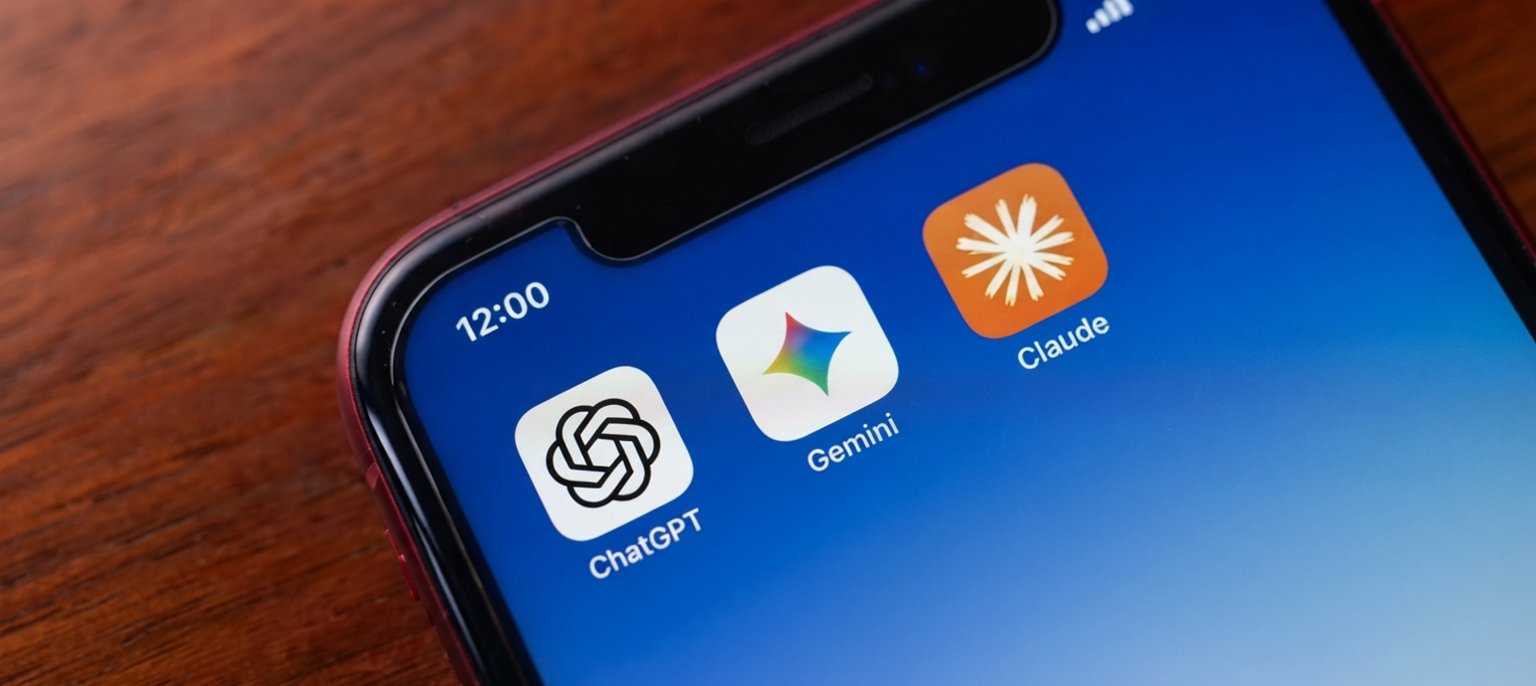
A close-up photograph of a smartphone screen displaying app icons for ChatGPT, Google Gemini, and Claude on a dark blue gradient background, illustrating a head-to-head comparison of leading 2026 AI models

So, here’s the answer none of those comparison articles in this space will tell you outright: none of them wins everything and the difference between them is minimal.

The overall text ranking (the biggest independent AI ranking in the world, for the LMArena) is where the top five models are clustered together within around 55 Elo points. This is the narrowest line up the leaderboard has ever had. All four models are at a level of capability that was not seen a year ago and each is very different in how it does it.

So, the question is not which is the “best. The answer is that’s not the same thing as which is best for what you actually need to do, and whether it’s worth paying for 4 separate subscriptions to get access to all 4 in 2026.

The 2026 Leaderboard: What Each Model Actually Wins

ChatGPT (GPT-5.5), The Polished Generalist

In 2026, GPT-5.5 will be the Swiss army knife of AI. It outperforms industry peers on 83% of the knowledge-work benchmarks in GDPval, and on 75% of the desktop automation benchmarks in OSWorld, outperforming every other frontier model, with a human baseline of 72.4%. It is the first time any AI has been more effective than humans at computer use related tasks.
While both Gemini and Grok write well, they’re prone to a more academic or snarky tone, respectively, while ChatGPT always delivers the most polished text, has Canvas for collaborative editing, and has the best sense of tone. ChatGPT is the go-to option for most users for its versatility, maturity, and the broad spectrum of tasks it can handle.

ChatGPT wins at: Agentic tasks, computer automation, general writing polish, ecosystem integration, and consistent cross-domain performance.

ChatGPT costs: Plus at $20/month. Pro restructured in August 2026 into two tiers at $100/month and above.

Claude Opus 4.8, The Precision Writer and Coding Workhorse

Claude has been taking the crown for writing for three years and will do so in 2026. Claude leads the pack on both factors: coding quality and output length, while Claude Opus 4.8 achieves an output of 1,606 Elo on expert tasks, which is a measurable edge over the competition; the Sonnet and Opus versions of Claude excel at working with large codebases, with a context window of 1M tokens that allow you to feed entire repositories and retain coherence.
By having no hallucination rate, Claude 4.1 Opus sets the bar for AA-Omniscience knowledge calibration. If you need accuracy to be unmistakable, such as for legal documents, technical documentation, client-facing content or intricate multi-file code refactoring, Claude is the go to model with the least risk of failure.

Claude wins at: Long-form writing, coding precision, factual accuracy, multi-step reasoning, and content that cannot afford hallucinations.

Claude costs: Pro at $20/month. Max at higher tiers.

Gemini 3.1 Pro, The Scientific Reasoner and Cost Leader

For reasoning benchmarks, Gemini’s ARC-AGI-2 score of 77.1% is the highest in the public benchmarks as of April 2026. Gemini 3.1 Pro always leads the pack in multi-step logical deduction, science problem solving and analytical thinking tasks at the graduate level.
The value proposition is also impressive, with Gemini providing the lowest cost output as well as the highest free tier of the four models. When it comes to generating research, analyzing data, and producing technical content, teams with higher volume requirements and a budget to match are best suited for operating at scale with Gemini’s API pricing of $3/million input tokens.

Gemini wins at: Formal reasoning, scientific analysis, structured research, image style consistency across campaigns, and value at high API volume.

Gemini costs: Google AI Pro at $19.99/month, the lowest standard tier of the four.

Grok 4, The Real-Time Intelligence Engine

Technical differentiation in 2026 is specific and true: The unique thing about Grok is live access to X (Twitter) – it is able to read posts, reply and get the trending topics in real-time, which no other frontier model can do. Grok has a structural advantage over a benchmark score for market intelligence, trend analysis, social listening, public sentiment and news-driven content.
Grok 4’s 2M token context window is more than double that of Gemini and Claude, allowing it to handle the most immense collections of documents, entire regulatory frameworks, or long stretches of content in a single inference.

Grok wins at: Real-time data, social and market intelligence, trend-responsive content, and extreme long-context tasks.

Grok costs: SuperGrok at $30/month, 50% more expensive than ChatGPT Plus or Claude Pro for the equivalent tier.

The Problem No One in This Comparison Is Talking About

Here is what 99% of ChatGPT vs Claude vs Gemini vs Grok comparison articles get wrong: they treat the choice as binary. Pick one. Commit.

Per the Suprmind Multi-Model Divergence Index, April 2026 Edition based on 1,324 real production turns, 99.1% of multi-model turns produced at least one contradiction, correction, or unique insight that no single model generated alone. Read that number again. In 99.1% of real working sessions, using multiple models together produced something that using any one model alone would have missed. The research question is not which model wins. 

The operational question is: why are you only using one?

The average professional content team or marketing operation in 2026 is running Claude for copy, ChatGPT for ideation, Gemini for research, and Grok for trend intelligence, across four separate browser tabs, four separate login credentials, four separate monthly subscriptions, and four separate credit systems that each expire, reset, and charge overages on their own schedules.

That is not a workflow. That is four workflows duct-taped together.

The Real Monthly Cost of Running All Four Separately

Let us put actual numbers on what the “pick your model” approach actually costs.


Model

Standard Plan

Annual Cost

ChatGPT Plus (GPT-5.5)

$20/month

$240/year

Claude Pro (Opus 4.8)

$20/month

$240/year

Google AI Pro (Gemini 3.1)

$19.99/month

$239/year

SuperGrok (Grok 4)

$30/month

$360/year

Combined total

$89.99/month

$1,079/year

And this is before any API overage, before any team seat licensing, before any additional creative tools for video, voiceover, image generation, or social scheduling. $1,079 per year, for models alone, with zero creative infrastructure around them.

You Do Not Have to Choose, And You Do Not Have to Pay Four Times

Access every frontier model, GPT, Claude, Gemini, and Grok, from a single workspace, under one lifetime payment 

Pyxa AI provides you with GPT-5.5, Claude Opus 4.8, Gemini 3.5 and Grok 4.3 (plus 150+ more AI models) all on one dashboard, one login, with one annual token allocation that lasts until the end of the year and doesn’t impose monthly caps or volume penalties.
No subscription juggling! No stress or anxiety about a credit system. No “I need Claude for this” but I already used up my ChatGPT this month” back and forth.No “I need Claude for this” but I already used up my ChatGPT this month” back and forth. You start one platform, choose the model that is most appropriate for the task in front of you and you get the output. If then you proceed to the next task. The comparison articles all lack this as they are geared towards those who think the decision is a foregone conclusion. It is not.

The Full Stack That Makes the Model Access Matter Even More

Being able to access the very best AI models around the world is important. It’s more important how you use that access. The model comparison moves from a procurement challenge to a creative tool within Pyxa AI’s comprehensive creative platform, which includes the full suite of tools for writing, video, voice, and 150+ AI models, all under a single payment.

Write precise script in Claude. Do a research of the trend angle in Grok for real time accuracy. Create the concept copy using ChatGPT for well-crafted copy. Analytically verify the research layer with Gemini. After that, import this work into the same platform; create studio-quality AI voiceovers with the right model for your brand voice and voice; create cinematic video generation with Google VEO 3.1 and KLING AI 2.5; create, schedule and distribute content without changing tabs across each platform.

As smartest content teams and the smartest in the country start to outrank and outproduce their peers one after another, they’re not debating ChatGPT versus Claude. They’ve rendered the question moot by running a website with a line of “for this task, which ever model is most appropriate.

Final Thought: The Decision That Pays for Itself in Six Weeks

At $89.99/month for four standalone subscriptions, Pyxa AI’s lifetime plan pays for itself in six weeks. Then the monthly billing stops, permanently. Annual tokens refresh at no additional cost. Every model update that OpenAI, Anthropic, Google, and xAI ship goes into the platform without a price increase on your end.

The math is not complicated. The decision just needs to be made.

Stop paying four separate subscriptions, own the full AI stack, every model, for one lifetime price starting at $49.99